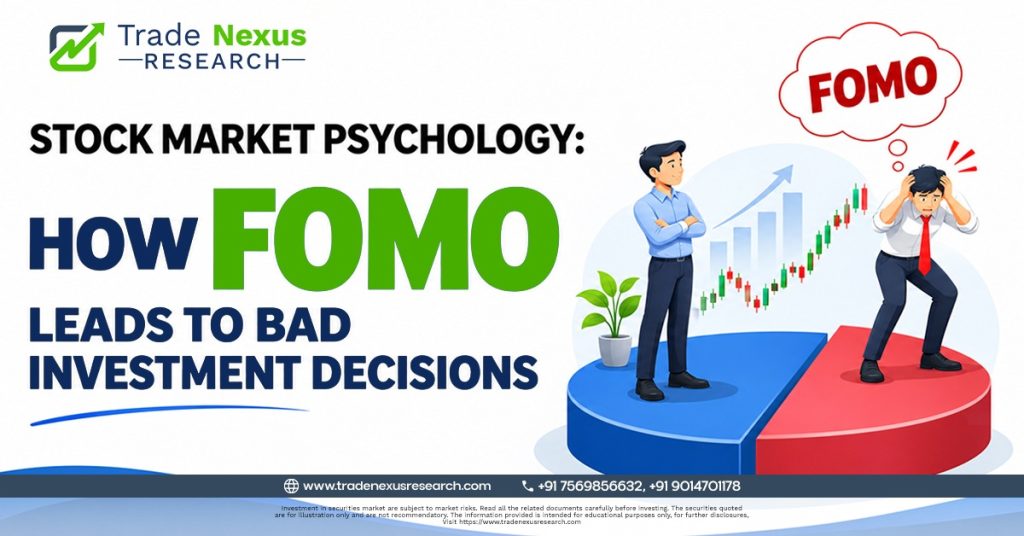
The stock market creates numerous opportunities for investors to grow their wealth, but making the right investment decision requires patience, knowledge, and proper research. Many investors enter the market with the goal of earning profits, but emotions can sometimes influence their decisions and lead to unexpected losses. One of the most common emotional challenges investors face is FOMO (Fear of Missing Out).
FOMO occurs when investors see a particular stock increasing in value and feel pressured to invest immediately because they believe they might miss a profitable opportunity. Instead of analysing the company’s financial performance, market position, and future growth potential, they make decisions based on excitement and market trends.
Understanding Stock Market Psychology is important because investment decisions are not always based on financial information. Emotions such as fear, greed, excitement, and overconfidence can influence how investors react to market movements. Learning to control these emotions can help investors develop a disciplined approach and make more informed financial decisions.
What Is FOMO in the Stock Market?
FOMO, or Fear of Missing Out, refers to the anxiety investors experience when they believe others are benefiting from an investment opportunity that they have missed.
For example, imagine a stock that increases by 20% within a few trading sessions. Investors begin discussing it on social media, financial news platforms, and online trading communities. Seeing others share their profits may create pressure to purchase the same stock.
Many investors enter at higher price levels without checking whether the company’s valuation supports the current market price. If the stock experiences a correction, these investors may face losses.
This behaviour highlights the importance of Stock Market Psychology. Successful investing is not about participating in every market opportunity. It is about identifying suitable opportunities through research and understanding the associated risks.
Why Does FOMO Make Investors Buy at the Wrong Time?
FOMO-driven investment decisions usually develop because of emotional reactions and external influences. Understanding these factors can help investors recognise unhealthy trading habits.
1. Following Popular Market Trends
When a stock becomes popular, investors often assume that its increasing demand will continue. They may purchase shares simply because everyone else is discussing them.
However, market popularity does not always indicate strong financial performance. Investors should evaluate business fundamentals, earnings, valuation, and future growth prospects before making investment decisions.
2. Fear of Missing Profits
Investors sometimes believe that waiting for the right opportunity will result in missed profits. This creates pressure to buy immediately, even when the stock has already experienced a significant price increase.
Such decisions can result in purchasing stocks at inflated valuations and expose investors to unnecessary risks.
3. Social Media and Market Hype
Social media platforms have made stock market discussions more accessible. Investors regularly come across trending stock recommendations, screenshots of trading profits, and predictions about future market movements.
However, not every recommendation is supported by proper research. Following unverified information can influence investment decisions and create unrealistic expectations.
4. Lack of Investment Planning
Investors who enter the market without clear financial goals or a defined strategy may be more vulnerable to emotional decisions.
Without an investment plan, every market movement can appear like an opportunity or a potential threat. Having a clear strategy helps investors remain focused during market fluctuations.
How FOMO Affects Stock Market Investments
FOMO can influence investment behaviour in several ways and negatively affect long-term financial performance.
Buying at Higher Prices: Investors may purchase stocks after a significant price increase, leaving limited room for further upside.
Ignoring Company Fundamentals: Excitement about rising prices can cause investors to overlook financial statements, business performance, and company valuations.
Frequent Trading: Investors may repeatedly enter and exit positions because they want to benefit from every market movement.
Poor Risk Management: Emotional decisions can encourage investors to take larger positions than their financial situation or risk tolerance allows.
Panic Selling: When prices decline, investors who entered due to FOMO may sell their holdings out of fear rather than evaluating the actual situation.
Understanding these behaviours is an important part of developing a healthy investment mindset.
The Role of Greed and Fear in Stock Market Psychology
Greed and fear are two powerful emotions that influence investor decisions.
Greed often encourages investors to expect higher returns and take additional risks. When stock prices increase, some investors become overconfident and continue purchasing shares without evaluating whether the current valuations are reasonable.
Fear creates the opposite reaction. When markets decline, investors may panic and sell their holdings without understanding the reasons behind the correction.
These emotional reactions can create a cycle of buying at high prices and selling at low prices.
Understanding Stock Market Psychology helps investors recognise these patterns and focus on research-based decisions instead of reacting to short-term market movements.
How to Avoid FOMO in Stock Market Trading
Avoiding FOMO does not mean ignoring market opportunities. It means developing the discipline to evaluate opportunities before investing.
1. Conduct Proper Research Before Investing
Before purchasing any stock, investors should understand the company’s business model, financial performance, revenue growth, profitability, and competitive position.
Research helps investors distinguish between companies with strong fundamentals and stocks that are temporarily gaining attention.
2. Follow a Clear Investment Strategy
Every investor should have a defined investment objective based on their financial goals, investment horizon, and risk tolerance.
A well-planned strategy helps reduce impulsive decisions and keeps investors focused on their long-term objectives.
3. Understand Stock Valuations
A company may be performing well, but its stock price may already reflect high growth expectations. Investors should consider valuation metrics such as the Price-to-Earnings (P/E) ratio, Price-to-Book (P/B) ratio, and other relevant financial indicators.
Understanding valuations helps investors avoid purchasing stocks simply because their prices are rising.
4. Avoid Blindly Following Stock Market Tips
Recommendations from social media, online communities, and unverified sources should not replace independent research.
Investors should understand the reasoning behind a recommendation, evaluate the supporting information, and consider the potential risks before making decisions.
5. Practise Patience and Risk Management
Not every market movement requires an immediate response. Investors should maintain a disciplined approach, diversify their portfolios where appropriate, and understand their risk exposure.
Patience and proper risk management can help investors avoid unnecessary trading decisions.
Why Stock Market Research Matters More Than Market Predictions
Many investors spend time searching for stocks that may deliver quick returns. However, predicting short-term price movements consistently is difficult, even for experienced market participants.
This is why research plays an important role in investment decision-making.
Reliable Stock Market Research involves studying company fundamentals, financial statements, industry developments, market trends, and potential risks. It provides a more structured foundation for evaluating investment opportunities.
Research-based decisions also help investors understand why a stock may be increasing or declining rather than simply reacting to its price movement.
Instead of chasing every trending stock, investors should focus on understanding the underlying business and evaluating whether an investment aligns with their objectives.
How Research-Driven Investing Helps Build Better Financial Decisions
Research-driven investing encourages investors to move away from emotional reactions and focus on financial information.
It offers several advantages:
- Better Understanding: Investors gain insights into company performance and market conditions.
- Informed Decisions: Financial analysis helps evaluate opportunities before investing.
- Risk Awareness: Research highlights potential challenges and investment risks.
- Investment Discipline: A structured approach reduces the influence of market excitement.
- Long-Term Perspective: Investors can focus on financial goals rather than temporary market trends.
At Trade Nexus Research, research and market insights are important elements of informed investment decision-making. Understanding market developments and evaluating available information can help investors approach the stock market with greater awareness.
Investors should remember that research does not eliminate market risk or guarantee returns. Every investment decision should consider individual financial objectives and risk tolerance.
Conclusion
FOMO is one of the common psychological challenges in stock market investing. It encourages investors to chase trending stocks, make impulsive purchases, and overlook important financial information. Although the fear of missing a profitable opportunity is natural, allowing emotions to control investment decisions can lead to unnecessary risks.
Understanding Stock Market Psychology helps investors recognise emotional behaviour and develop better financial discipline. By conducting proper research, understanding company valuations, following a clear investment strategy, and practising patience, investors can make more informed decisions.
Remember, missing one market opportunity is better than investing without understanding the risks. The goal should not be to participate in every market movement but to identify opportunities that align with your investment objectives.
Trade Nexus Research – Making informed investment decisions through research, analysis, and market insights.
Frequently Asked Questions (FAQs)
1. What is FOMO in the stock market?
FOMO, or Fear of Missing Out, is an emotional response in which investors feel pressured to purchase a stock because they believe others are making profits or that they may miss a potential opportunity.
2. How does FOMO affect stock market decisions?
FOMO can encourage investors to buy stocks at higher prices, ignore company fundamentals, follow market trends blindly, and make impulsive trading decisions.
3. How can investors avoid FOMO in trading?
Investors can avoid FOMO by conducting proper research, following a clear investment strategy, understanding stock valuations, managing risks, and avoiding unverified recommendations.
4. Why is stock market psychology important?
Stock market psychology helps investors understand how emotions such as fear, greed, and overconfidence influence financial decisions. It encourages disciplined and informed investing.
5. Why is stock market research important before investing?
Stock market research helps investors evaluate company fundamentals, financial performance, industry trends, valuations, and potential risks before making investment decisions.