Introduction
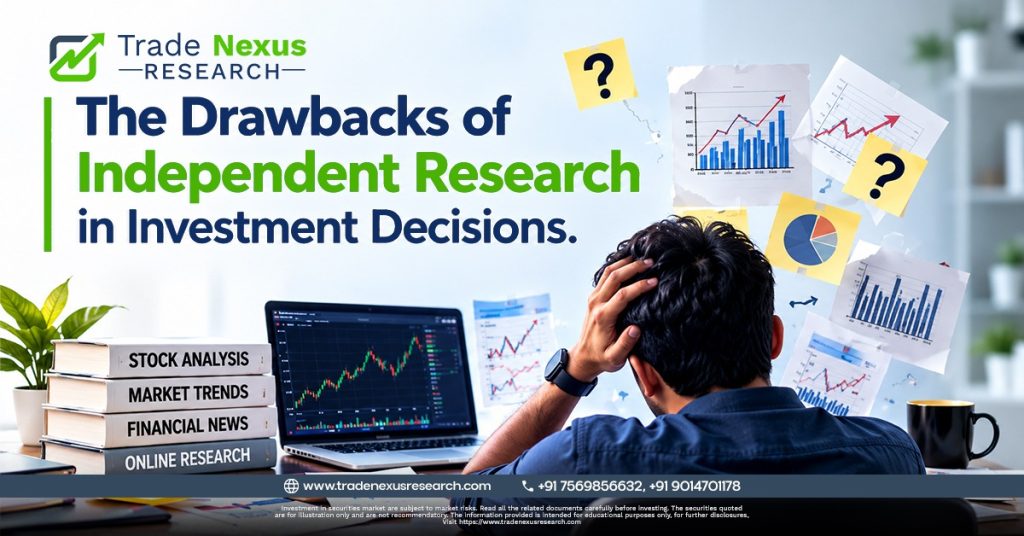
Investment research require careful analysis, financial knowledge, and an understanding of market conditions. Many investors conduct their own research before buying or selling stocks. While independent research helps investors understand the market and make informed decisions, it also comes with certain limitations. Without sufficient experience, reliable information, and proper analytical skills, investors may find it difficult to evaluate investment opportunities accurately.
Understanding the drawbacks of independent research in investment decisions can help investors recognise potential risks and develop a more structured approach to stock market research.
What Is Independent Research in Investment Decisions?
Independent research in investment decisions refers to analysing stocks, companies, financial statements, market trends, and economic factors without relying entirely on external research professionals or advisory services.
Investors may use company annual reports, financial news, stock market charts, economic data, and online resources to evaluate investment opportunities. Although this approach encourages financial awareness, interpreting complex information correctly can be challenging, especially for beginners.
1. Limited Financial Knowledge and Experience
One of the major drawbacks of independent research is the lack of specialised financial knowledge. Understanding financial statements, valuation ratios, company earnings, and market indicators requires practice and experience.
Investors without adequate knowledge may misinterpret financial data or overlook important factors affecting a company’s performance. This can lead to investment decisions based on incomplete or incorrect analysis.
2. Difficulty Identifying Reliable Information
The internet provides access to a large amount of financial information, but not all sources are accurate, unbiased, or up to date. Investors may encounter misleading stock tips, exaggerated market predictions, and unsupported claims.
Identifying credible sources and verifying information from official company disclosures and reliable financial resources is essential for making informed decisions.
3. Emotional Bias in Investment Decisions
Independent investors may allow fear, greed, overconfidence, or the fear of missing out (FOMO) to influence their decisions. For example, an investor may purchase a stock because its price is rising rapidly or sell an investment during temporary market volatility.
Emotional decisions can undermine a well-planned investment strategy. A disciplined research process can help investors evaluate opportunities more objectively.
4. Time-Consuming Research Process
Comprehensive investment research involves studying company financial statements, industry trends, economic developments, valuations, and potential risks. Keeping track of these factors requires considerable time and consistent effort.
For individuals balancing investments with professional or personal responsibilities, conducting detailed research regularly can become difficult.
5. Challenges in Understanding Market Volatility
Stock prices are influenced by numerous factors, including economic conditions, interest rates, corporate announcements, global developments, and investor sentiment. Even detailed research cannot predict every market movement.
Independent investors may find it difficult to distinguish between short-term price fluctuations and changes in a company’s long-term fundamentals.
6. Risk of Incomplete Analysis
Investors sometimes focus on a single indicator, such as recent price performance, revenue growth, or a popular financial ratio, while ignoring other important factors.
A thorough investment assessment should consider a company’s financial health, valuation, competitive position, management, industry outlook, and potential downside risks. Missing these elements may result in an incomplete understanding of an investment opportunity.
7. Limited Access to Advanced Research Tools
Professional investment research may involve specialised analytical tools, industry databases, financial modelling, and detailed valuation techniques. Individual investors may not have access to all these resources or the expertise required to use them effectively.
However, many useful resources are publicly available, including exchange disclosures, company filings, and financial statements. Investors can improve their research by learning to use these resources effectively.
How Can Investors Improve Their Independent Research?
Investors can make their research process more effective by following a few important practices:
- Use credible sources: Refer to official exchange filings, company annual reports, and verified financial disclosures.
- Develop financial knowledge: Learn fundamental analysis, technical analysis, valuation methods, and risk management.
- Avoid emotional decisions: Establish clear investment objectives and follow a consistent decision-making process.
- Evaluate multiple factors: Consider financial performance, valuation, industry conditions, and potential risks together.
- Verify investment claims: Do not rely solely on social media posts, unverified tips, or guaranteed-return promises.
- Understand personal risk tolerance: Ensure investment decisions align with financial goals, time horizon, and ability to bear losses.
Should Investors Rely Only on Independent Research?
Independent research can be valuable for building financial knowledge and understanding market behaviour. However, investors should recognise its limitations, particularly when analysing complex financial instruments or evaluating unfamiliar companies.
Depending on their needs, investors may consider consulting appropriately registered financial professionals or research analysts. Before engaging any service, they should verify the provider’s credentials, understand the scope of the service, and review the associated risks and fees.
No research method or advisory service can guarantee investment profits or eliminate market risk.
Conclusion
Understanding the drawbacks of independent research in investment decisions is an important step towards becoming a more informed investor. Limited expertise, unreliable information, emotional bias, time constraints, and incomplete analysis can affect the quality of investment decisions.
By developing financial knowledge, using credible sources, evaluating risks, and maintaining a disciplined approach, investors can strengthen their research process. At Trade Nexus Research, investor education and a better understanding of market research can help readers approach financial decisions with greater awareness and responsibility.
Disclaimer: This article is for educational and informational purposes only. It does not constitute investment advice or a recommendation to buy or sell any security. Investments in securities markets are subject to market risks. Please consult an appropriately qualified professional when necessary.