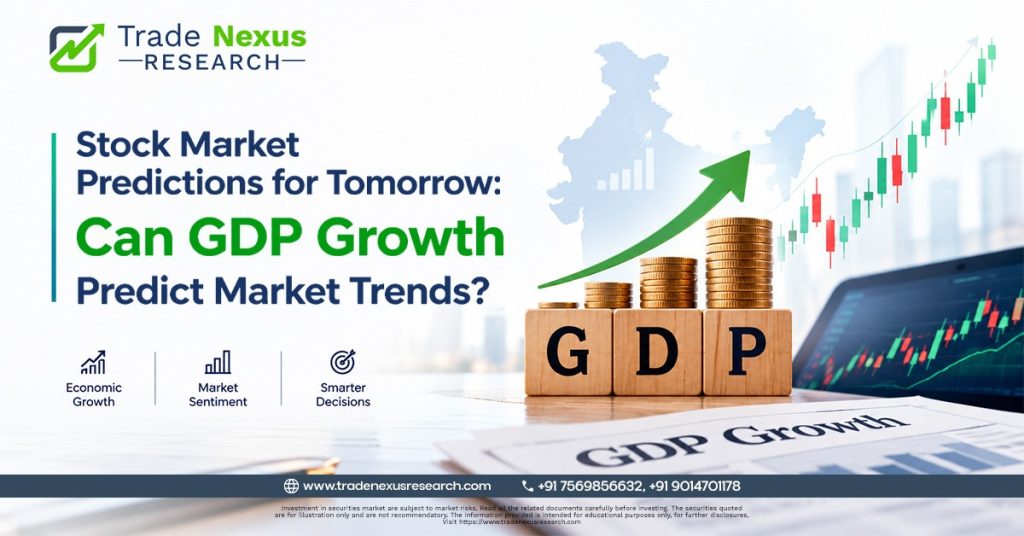
Investors constantly look for reliable ways to understand where the market could move next. Whether it is a rise in the Nifty 50, a fall in the Sensex, or a sudden movement in individual stocks, several economic and market factors influence investor sentiment. One factor that receives significant attention is Gross Domestic Product (GDP) growth. By understanding the relationship between economic growth and market performance, investors can develop a better approach to stock market predictions for tomorrow.
What Is GDP Growth and Why Does It Matter to Investors?
GDP measures the total value of goods and services produced within an economy over a specific period. When GDP growth is strong, it generally indicates that economic activity, business performance, consumption, and investment are improving. Strong economic growth can support corporate earnings and create a positive environment for equities.
However, GDP growth alone cannot determine the direction of the stock market. Markets respond to several factors, including inflation, interest rates, global markets, crude oil prices, corporate earnings, government policies, foreign investment flows, and investor sentiment. Therefore, GDP should be viewed as one important economic indicator rather than a standalone tool for stock market predictions for tomorrow.
Can GDP Growth Predict Stock Market Trends?
GDP growth can provide useful information about the broader economic environment, but it cannot accurately predict short-term market movements on its own. Stock markets are forward-looking, which means investors often react to expectations about future economic conditions before official GDP data is released.
For example, if investors expect stronger GDP growth, they may anticipate higher corporate earnings and increased business activity. This can support equity prices. On the other hand, weaker-than-expected GDP growth may create concerns about economic activity and earnings, potentially affecting market sentiment.
Therefore, GDP growth can help investors understand the larger market cycle, but stock market predictions for tomorrow require analysis of multiple market indicators.
How GDP Growth Can Influence the Nifty 50
The Nifty 50 represents 50 major companies listed on the National Stock Exchange. Many of these companies operate across sectors that are closely connected to India’s economic growth. Strong GDP growth can support sectors such as banking, financial services, automobiles, infrastructure, manufacturing, and consumer businesses.
When economic growth expectations improve, investors may become more optimistic about corporate earnings. This can influence the Nifty 50. However, global events, interest-rate decisions, foreign institutional investor activity, and company-specific developments can also cause significant short-term movements.
This is why investors looking for a nifty prediction for tomorrow should consider GDP alongside technical and fundamental indicators.
What Factors Matter for Nifty 50 Prediction Today?
A meaningful nifty 50 prediction today should consider both domestic and international market conditions. Global indices, Asian market performance, US market trends, crude oil prices, the Indian rupee, bond yields, and institutional flows can all influence market sentiment.
Domestic factors are equally important. RBI policies, inflation data, GDP announcements, corporate earnings, government decisions, and sector-specific developments can affect the Nifty 50.
As a result, today nifty 50 prediction should not be based on a single economic indicator. Investors should combine fundamental information with technical market analysis before making decisions.
Can GDP Help With Tomorrow Market Prediction?
GDP can contribute to a broader tomorrow market prediction, particularly when GDP data is significantly above or below market expectations. A stronger-than-expected economic outlook may improve investor confidence, while disappointing growth data could increase uncertainty.
However, the market may already have priced in expectations before the GDP announcement. This means the actual market reaction depends not only on the GDP figure but also on how it compares with what investors expected.
For this reason, GDP is more useful for understanding medium- and long-term market trends than for making an exact tomorrow share market prediction.
Why Stock Market Predictions for Tomorrow Are Difficult
Short-term stock market movements are influenced by numerous unpredictable events. A global economic announcement, geopolitical development, unexpected corporate news, or sudden change in institutional buying and selling can move the market within minutes.
Technical indicators such as support and resistance levels, moving averages, trading volumes, momentum, and market breadth can provide additional information. Fundamental indicators such as earnings growth, valuations, interest rates, and economic data can provide a longer-term perspective.
Combining these factors can make stock market predictions for tomorrow more structured, but no prediction can guarantee the exact direction of the market.
Nifty 50 Today Predictions vs Tomorrow Predictions
There is an important difference between analysing the market today and forecasting the next trading session. Nifty 50 today predictions are generally based on current market conditions, overnight global cues, technical levels, and news available before or during the trading session.
In contrast, stock prediction tomorrow requires investors to consider today’s closing levels, institutional activity, global market movements after Indian market hours, and any important economic or corporate announcements expected overnight.
Therefore, investors should regularly update their analysis rather than relying on an earlier prediction.
How Investors Can Approach Stock Market Forecast Tomorrow
A disciplined approach is more useful than trying to predict one exact market number. Investors can begin by reviewing global market cues and major economic developments. They can then analyse Nifty 50 and Sensex trends, sector performance, technical levels, institutional flows, and upcoming events.
Investors should also distinguish between an analytical forecast and a guaranteed outcome. A stock market forecast tomorrow represents a possible scenario based on available information, not a certainty.
Risk management is equally important. Position sizing, stop-loss strategies, diversification, and a clear investment objective can help investors manage unexpected market movements.
How Trade Nexus Research Can Help Investors
For investors who want to understand the market through structured research and analysis, Trade Nexus Research provides research-oriented insights into stocks, market trends, economic developments, and investment-related topics.
Rather than depending on a single stock prediction tomorrow, investors can use research and market analysis to understand the factors that may influence price movements. Trade Nexus Research can help investors explore fundamental factors, market developments, valuation concepts, and other important aspects of the stock market.
The objective should not simply be to guess tomorrow’s market direction. A stronger approach is to understand why the market may move, identify potential risks, and make decisions based on research and individual investment objectives.
GDP Growth Is One Piece of the Market Prediction Puzzle
GDP growth is an important indicator of economic health and can provide valuable context for understanding stock market trends. Strong economic growth can support corporate earnings and investor confidence, while weaker growth can create concerns about future business performance.
However, GDP cannot independently provide accurate stock market predictions for tomorrow. Short-term market movements depend on a combination of economic data, technical signals, corporate developments, global markets, interest rates, institutional flows, and investor sentiment.
For investors, the better approach is to use GDP as part of a broader analytical framework. Combining economic research with technical and fundamental analysis can provide a more informed perspective on potential market scenarios.
Frequently Asked Questions
Can GDP growth predict the stock market?
GDP growth can provide insight into the overall health of the economy, but it cannot accurately predict the stock market by itself. Investors should consider GDP along with earnings, interest rates, inflation, global markets, technical indicators, and other factors.
Can GDP growth help with stock market predictions for tomorrow?
GDP growth can provide broader economic context, but it is not sufficient for making short-term stock market predictions for tomorrow. Overnight global cues, technical levels, news, and institutional activity can have a stronger immediate impact.
What factors are important for Nifty prediction for tomorrow?
Important factors include global market trends, US and Asian market performance, crude oil prices, the rupee, institutional buying and selling, economic announcements, corporate news, and Nifty’s technical levels.
How reliable is a Nifty 50 prediction today?
A nifty 50 prediction today is an analytical estimate rather than a guaranteed outcome. Market conditions can change quickly because of unexpected economic, political, corporate, or global events.
Can GDP growth affect Nifty 50?
Yes. GDP growth can influence investor expectations about economic activity and corporate earnings, which may affect the Nifty 50. However, the actual market impact depends on expectations and other market conditions.
Where can investors research stock market trends?
Investors can use financial news, company disclosures, economic data, market indicators, and professional research platforms. Trade Nexus Research can also be explored for research and insights related to stocks, markets, and investment concepts.
Is tomorrow share market prediction guaranteed?
No. A tomorrow share market prediction is not guaranteed. Stock prices can change unexpectedly due to news, global events, market sentiment, and other factors. Investors should consider risk before making investment decisions.